Policy reports
The challenge we face
Two families a week are given the devastating diagnosis that their child has Duchenne and the condition deeply impacts not just those living with it but also those who love and care for them - seriously affecting the lives of thousands of people.
They all live with this pain and struggle largely unnoticed by most of the UK. That is mainly because it is a rare disease – and the Duchenne experience tells us a lot about what it is like to live with a rare disease.
Our report about life in the UK with Duchenne
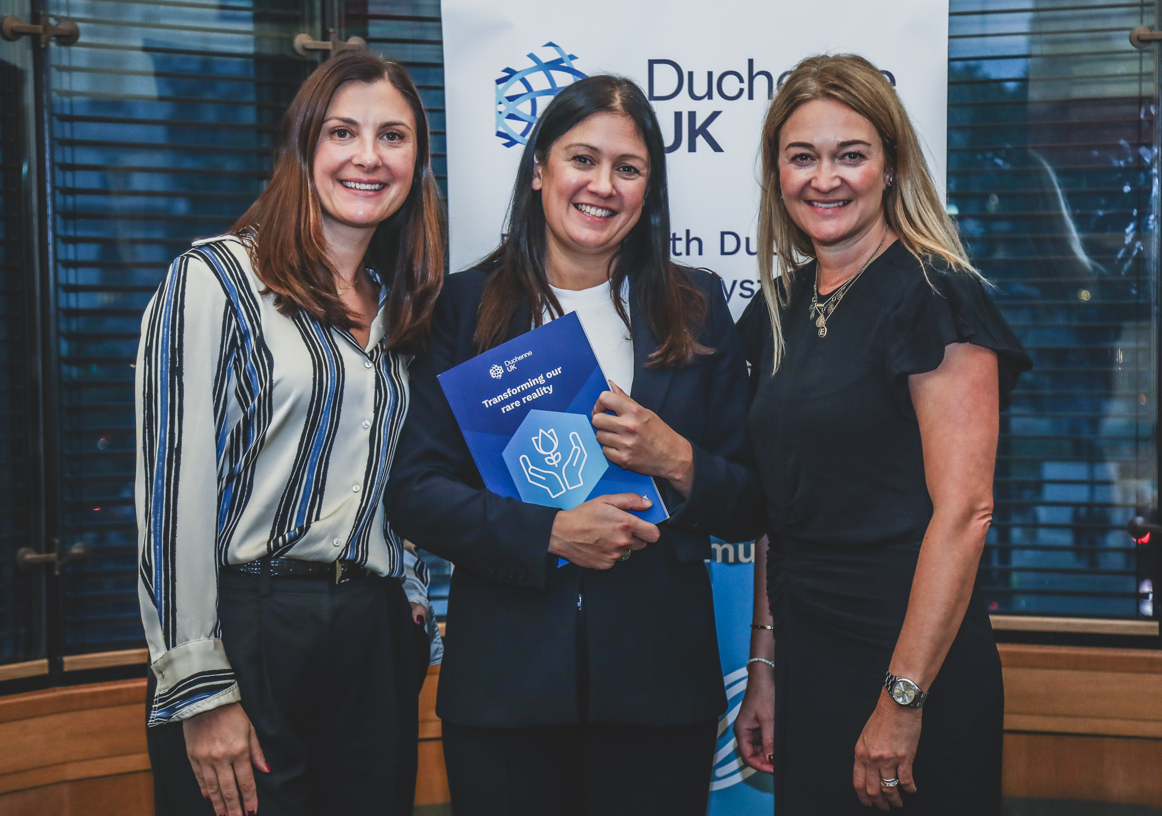
Our most recent report, Transforming Our Rare Reality, sets out the state of the Duchenne nation in the UK. It outlines the current landscape across five key areas: care, treatment, research, technological innovation, and awareness of Duchenne.
It shows the progress that has been made and the role of our incredible community in driving forward much of this progress, and the obstacles that still need to be overcome. It sets out a framework for change that we want to see in each of these areas, and many of these policy solutions are applicable to other rare diseases.

Duchenne UK's policy recommendations
- The UK Government should look at how trial capacity can be increased at existing Centres of Excellence.
- We encourage the National Institute for Health and Care Research (NIHR) to work with charities to help provide seed funding to enable Trusts to recruit posts to facilitate clinical trials and develop expertise – these posts can become self-sustaining through income from the pharmaceutical industry. This has been proven to work in our model: the Duchenne Hub UK.
- We encourage the NIHR to work with charities to further streamline site set-up and support the development of a resource registry.
- The UK Government should work with National Institute for Health and Care Excellence (NICE) and the Medicines and Healthcare products Regulatory Agency (MHRA) to produce best practice in clinical trials to ensure the information regulators need to make assessments is collected from the start. They can draw on our Project HERCULES experience.
- We invite opportunities to collaborate on the development of advanced therapies and gene therapy innovation, building on our investment in research in this area, and opportunities to facilitate academic led research.
- Duchenne treatments should be appraised via the Highly specialised technology (HST) route instead of Single technology appraisal (STA). HST committees are used to dealing with uncertainty – they can approach these diseases with the pragmatism, sensitivity, and flexibility which the HST route affords, and which a STA does not. To do this, NICE should replace the new criteria for HST with a system that recognises challenging, paediatric, life-limiting, progressive diseases that are complex and need to be treated differently to more common and less complex diseases, which would enable diseases like Duchenne to qualify for the HST route.
- Carer QoL must be included in health technology assessments. It’s currently sometimes considered in a qualitative way but this means there is uncaptured value in a product which can’t be translated into anything that is useful for a quantitative-focused quality-adjusted life year (QALY). If a caregiver quality of life (QoL) metric was included, the cost effectiveness arithmetic of medicines for rare diseases and complex paediatric progressive life-limiting conditions would change dramatically.
- The disabling nature of diseases such as Duchenne adds a significant physical and mental burden and requires significant support from the care system as well as the health system. The costs associated with social services and social care such as Personal Independent Payments, Education, Health and Care Plans, Disability Living Allowance, should be included in health technology assessments.
- The Minister of State for Social Security and Disability should invite a coalition of disabled people and patient advocacy groups to create a quality standard for equipment provision, in the same way that NHS England has commissioned the National Wheelchair Alliance to devise a quality standard for wheelchair services in England.
- The Government should require each Local Authority to find out how many people in its region have Duchenne and will need its services, and assess the equipment they will need to live well with it. The Government should use this information to pool and ringfence a national budget which Local Authorities can draw on.
- The Personal Wheelchair Budget should be extended to assistive technology so that people have individual budgets to cover the cost of their assistive technology but to which they can add their own finances if they chose.
- The Government should review how this could be integrated with payments for care such as Direct Payments and Carer’s Allowance to avoid duplication in the system.
- We invite opportunities to collaborate on supporting the next generation of neuromuscular clinicians by providing fellowships to attract healthcare professionals into the specialism.
- We invite the NHS to work with us on a pilot for a new model of care, a virtual hospital ward. It would support the joining up of people involved in a patient’s health and virtual care. It wouldn’t replace in-patient care or in-person appointments but could complement it and allow different members of a patient’s multidisciplinary care to work together.
- NICE to include the Duchenne Care UK clinical guidelines as part of its treatment guidelines for Duchenne.
- The establishment of clinically driven regional networks of key neuromuscular stakeholders including doctors, allied health professionals, established North Star neuromuscular clinical centres, NHS managers, commissioners, patients, carers and relatives of patients. The network would aim to develop and establish world class and equitable care for people of all ages living with rare neuromuscular conditions in the region, and to improve their quality of life and overall experience of NHS services. This would involve working with health and social care professionals to develop the appropriate services and increase the knowledge and skills required to manage these complex conditions. It would be modelled on the South West Neuromuscular Operational Delivery Network, which is the only Neuromuscular Operational Delivery Network in the UK.
- An NHS awareness campaign aimed at increasing understanding of Duchenne and associated care guidelines, targeted at healthcare professionals that deliver specialist care to Duchenne patients. This would include the development of three training modules on Duchenne and the care guidelines, one each for primary, secondary and tertiary care.
- Establish neuromuscular diseases as paediatric sub-specialist training for doctor and health care professionals to ensure the next generation of experts.
- Introduce neuromuscular care co-ordinators or care advisors at each specialist centre to support the delivery of care.
- NHS in England, Scotland, Wales and Northern Ireland to work with Duchenne UK on developing a Centre of Excellence badge that can be awarded to centres delivering Duchenne care and running Duchenne clinical research trials to a very high standard.
- The governments in each of the four nations should fund awareness campaigns to improve understanding of the range of neuromuscular conditions. This should be led by input from the neuromuscular community, with the relevant government department and public health body in each nation, in close collaboration with local health systems, clinicians, and other relevant specialists.
- The awareness campaigns should be targeted at healthcare and education professionals, along with materials published online and in print for the public.
- Parents and carers should be offered emergency trauma support following the diagnosis of their child with Duchenne.
- People with Duchenne and their parents and carers should be offered psychosocial support from someone trained in Duchenne when they enter each new stage of Duchenne.